

Guides • Perfecting your Craft
Last updated on Nov 23, 2022
How to Write a Poem: Get Tips from a Published Poet
Ever wondered how to write a poem? For writers who want to dig deep, composing verse lets you sift the sand of your experience for new glimmers of insight. And if you’re in it for less lofty reasons, shaping a stanza from start to finish can teach you to have fun with language in totally new ways.
To help demystify the subtle art of writing verse, we chatted with Reedsy editor (and published poet) Lauren Stroh. In 8 simple steps, here's how to write a poem:
 Click to tweet!
1. Brainstorm your starting point
If you’re struggling to write your poem in order from the first line to the last, a good trick is opening with whichever starting point your brain can latch onto as it learns to think in verse.
Your starting point can be a line or a phrase you want to work into your poem, though it doesn’t have to take the form of language at all. It might be a picture in your head, as particular as the curl of hair over your daughter’s ear as she sleeps, or as capacious as the sea. It can even be a complicated feeling you want to render with precision — or maybe it's a memory you return to again and again. Think of this starting point as the "why" behind your poem, your impetus for writing it in the first place.
If you’re worried your starting point isn’t grand enough to merit an entire poem, stop right there. After all, literary giants have wrung verse out of every topic under the sun, from the disappointments of a post-Odyssey Odysseus to illicitly eaten refrigerated plums.

As Lauren Stroh sees it, your experience is more than worthy of being immortalized in verse.
"I think the most successful poems articulate something true about the human experience and help us look at the everyday world in new and exciting ways."
2. Free-write in prose first
It may seem counterintuitive but if you struggle to write down lines that resonate, perhaps start with some prose writing first. Take this time to delve into the image, feeling, or theme at the heart of your poem, and learn to pin it down with language. Give yourself a chance to mull things over before actually writing the poem.
Take 10 minutes and jot down anything that comes to mind when you think of your starting point. You can write in paragraphs, dash off bullet points, or even sketch out a mind map. The purpose of this exercise isn’t to produce an outline: it’s to generate a trove of raw material, a repertoire of loosely connected fragments to draw upon as you draft your poem in earnest.
Silence your inner critic for now
And since this is raw material, the last thing you should do is censor yourself. Catch yourself scoffing at a turn of phrase, overthinking a rhetorical device, or mentally grousing, “This metaphor will never make it into the final draft”? Tell that inner critic to hush for now and jot it down anyway. You just might be able to refine that slapdash, off-the-cuff idea into a sharp and poignant line.
3. Choose your poem’s form and style
Whether you’ve free-written your way to a beginning or you’ve got a couple of lines jotted down, before you complete a whole first draft of your poem, take some time to think about form and style.
The form of a poem often carries a lot of meaning beyond the structural "rules" that it offers the writer. The rhyme patterns of sonnets — and the Shakespearean influence over the form — usually lend themselves to passionate pronouncements of love, whether merry or bleak. On the other hand, acrostic poems are often more cheeky because of the secret meaning that it hides in plain sight.
Even if your material begs for a poem without formal restrictions, you’ll still have to decide on the texture and tone of your language. Free verse, after all, is as diverse a form as the novel, ranging from the breathless maximalism of Walt Whitman to the cool austerity of H.D. Where, on this spectrum, will your poem fall?

Choosing a form and tone for your poem early on can help you work with some kind of structure to imbue more meanings to your lines. And if you’ve used free-writing to generate some raw material for yourself, a structure can give you the guidance you need to organize your notes into a poem.
4. Read for inspiration
A poem isn’t a nonfiction book or a historical novel: you don’t have to accumulate reams of research to write a good one. That said, a little bit of outside reading can stave off writer’s block and keep you inspired throughout the writing process.
Build a short, personalized syllabus around your poem’s form and subject. Say you’re writing a sensorily rich, linguistically spare bit of free verse about a relationship of mutual jealousy between mother and daughter. In that case, you’ll want to read some key Imagist poems, alongside some poems that sketch out complicated visions of parenthood in unsentimental terms.

And if you don’t want to limit yourself to poems similar in form and style to your own, Lauren has you covered with an all-purpose reading list:
- The Dream of a Common Language by Adrienne Rich
- Anything you can get your hands on by Mary Oliver
- The poems “Failures in Infinitives” and “Fish & Chips” by Bernadette Mayer.
- I often gift Lunch Poems by Frank O’Hara to friends who write.
- Everyone should read the interviews from the Paris Review’s archives. It’s just nice to observe how people familiar with language talk when they’re not performing, working, or warming up to write.
5. Write for an audience of one — you
Even with preparation, the pressure of actually producing verse can still awaken your inner metrophobe (or poetry-fearer). What if people don’t understand — or even misinterpret — what you’re trying to say? What if they don’t feel drawn to your work? To keep the anxiety at bay, Lauren suggests writing for yourself, not for an external audience.
"I absolutely believe that poets can determine the validity of their own success if they are changed by the work they are producing themselves; if they are challenged by it; or if it calls into question their ethics, their habits, or their relationship to the living world. And personally, my life has certainly been changed by certain lines I’ve had the bravery to think and then write — and those moments are when I’ve felt most like I’ve made it."
You might eventually polish your work if you decide to publish your poetry down the line. (If you do, definitely check out the rest of this guide for tips and a list of magazines to submit to.) But as your first draft comes together, treat it like it’s meant for your eyes only.
6. Read your poem out loud
A good poem doesn’t have to be pretty: maybe an easy, melodic loveliness isn’t your aim. It should, however, come alive on the page with a consciously crafted rhythm, whether hymn-like or discordant. To achieve that, read your poem out loud — at first, line by line, and then all together, as a complete text.
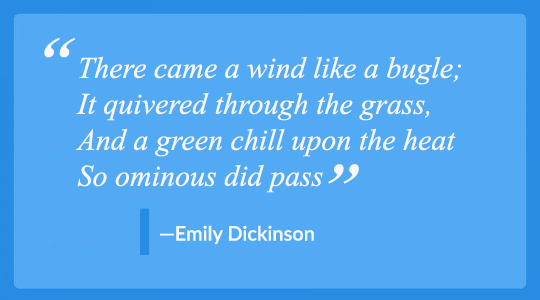
Trying out every line against your ear can help you weigh out a choice between synonyms — getting you to notice, say, the watery sound of “glacial”, the brittleness of “icy,” the solidity of “cold”.
Reading out loud can also help you troubleshoot line breaks that just don't feel right. Is the line unnaturally long, forcing you to rush through it or pause in the middle for a hurried inhale? If so, do you like that destabilizing effect, or do you want to literally give the reader some room to breathe? Testing these variations aloud is perhaps the only way to answer questions like these.
7. Take a break to refresh your mind
While it’s incredibly exciting to complete a draft of your poem, and you might be itching to dive back in and edit it, it’s always advisable to take a break first. You don’t have to turn completely away from writing if you don’t want to. Take a week to chip away at your novel or even muse idly on your next poetic project — so long as you distance yourself from this poem a little while.
This is because, by this point, you’ve probably read out every line so many times the meaning has leached out of the syllables. With the time away, you let your mind refresh so that you can approach the piece with sharper attention and more ideas to refine it.
8. Have fun revising your poem
At the end of the day, even if you write in a well-established form, poetry is about experimenting with language, both written and spoken. Lauren emphasizes that revising a poem is thus an open-ended process that requires patience — and a sense of play.
"Have fun. Play. Be patient. Don’t take it seriously, or do. Though poems may look shorter than what you’re used to writing, they often take years to be what they really are. They change and evolve. The most important thing is to find a quiet place where you can be with yourself and really listen."
Is it time to get other people involved?
Want another pair of eyes on your poem during this process? You have options. You can swap pieces with a beta reader, workshop it with a critique group, or even engage a professional poetry editor like Lauren to refine your work — a strong option if you plan to submit it to a journal or turn it into the foundation for a chapbook.

Want a poetry expert to polish up your verse?
Professional poetry editors are on Reedsy. Sign up for free to meet them!
Learn how Reedsy can help you craft a beautiful book.
The working poet's checklist
If you decide to fly solo, here’s a checklist to work through as you revise:
✅ Hunt for clichés. Did you find yourself reaching for ready-made idioms at any point? Go back to the sentiment you were grappling with and try to capture it in stronger, more vivid terms.
✅ See if your poem begins where it should. Did you take a few lines of throat-clearing to get to the actual point? Try starting your poem further down.
✅ Make sure every line belongs. As you read each line, ask yourself: how does this contribute to the poem as a whole? Does it advance the theme, clarify the imagery, set or subvert the reader’s expectations? If you answer with something like, “It makes the poem sound nice,” consider cutting it.
Once you’ve worked your way through this checklist, feel free to brew yourself a cup of tea and sit quietly for a while, reflecting on your literary triumphs.
Whether these poetry writing tips have awakened your inner Wordsworth, or sent you happily gamboling back to prose, we hope you enjoyed playing with poetry — and that you learned something new about your approach to language.
And if you are looking to share your poetry with the world, the next post in this guide can show the ropes regarding how to publish your poems!


1 response
Anna Clarke says:
29/03/2020 – 04:37
I entered a short story competition and though I did not medal, one of the judges told me that some of my prose is very poetic. The following year I entered a poetry competition and won a bronze medal. That was my first attempt at writing poetry. I am more aware of figurative language in writing prose now. I am learning to marry the two. I don't have any poems online.